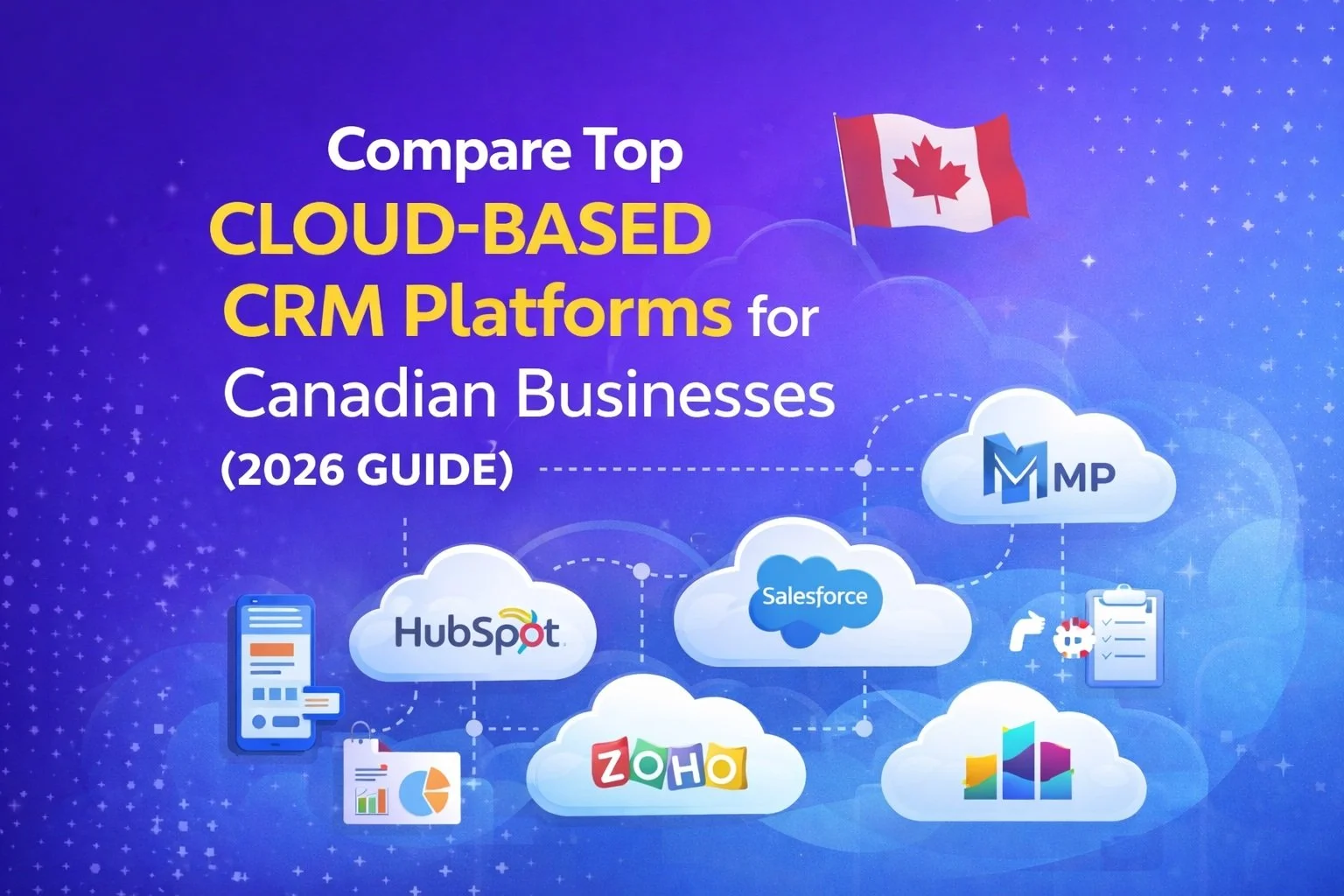
Compare Top Cloud-Based CRM Platforms for Canadian Businesses
Introduction
Cloud-based CRM platforms have become the operational backbone of modern Canadian businesses.
Whether you're managing sales pipelines, nurturing leads, sending campaigns, or tracking revenue forecasts, your CRM is no longer just a contact database. It is your control center.
But with dozens of platforms claiming to be the “best,” how do you choose the right one?
This guide compares the top cloud-based CRM platforms used by Canadian businesses in 2026 — and explains what truly matters when making a decision.
What “Cloud-Based CRM” Really Means
A cloud-based CRM:
✔ Is accessible anywhere
✔ Stores data securely in the cloud
✔ Updates automatically
✔ Scales with business growth
✔ Often includes built-in automation tools
Unlike on-premise systems, cloud CRM requires no internal servers and supports remote teams easily.
What Canadian Businesses Should Prioritize in 2026
Before diving into brand names, let’s define what actually matters.
Canadian small businesses should prioritize:
✔ Automation That Works Out of the Box
Not “upgrade to unlock automation.” Real, usable workflows from day one.
✔ Integrated Marketing Tools
Email campaigns, follow-up sequences, client communication — inside the CRM, not bolted on.
✔ Transparent Pricing
Clear tier structures without surprise add-ons or forced upgrades.
✔ Ease of Use
A CRM should feel intuitive within days, not require consultants.
✔ Canadian Awareness
Compliance, communication standards, and business workflows vary by country. Alignment matters.
With that framework in mind, here are the major platforms Canadian businesses typically evaluate.
Top Cloud-Based CRM Platforms
HubSpot CRM
Best for: Marketing-driven teams
Strengths:
Generous free tier
Strong inbound marketing ecosystem
Excellent analytics
Considerations:
Automation and advanced marketing features increase costs quickly
Pricing scales sharply as contacts grow
HubSpot is powerful, particularly for marketing-heavy operations, but costs can compound as your business expands.
Salesforce Sales Cloud
Best for: Large enterprises and complex sales organizations
Strengths:
Deep customization
Enterprise-level reporting
Extensive integrations
Considerations:
Steep learning curve
Often requires technical configuration
Premium pricing
Salesforce is a market leader for large organizations. For smaller teams, it can feel heavy and complex.
Zoho CRM
Best for: Budget-conscious businesses
Strengths:
Competitive pricing tiers
Modular feature options
Broad functionality
Considerations:
Interface can feel fragmented
Automation requires configuration
Zoho offers flexibility but may require more manual setup to achieve streamlined workflows.
Pipedrive
Best for: Pipeline-focused small teams
Strengths:
Clean visual pipeline
Simple onboarding
Sales-centric design
Considerations:
Limited built-in marketing tools
Automation depth is moderate
Pipedrive is strong for visual deal tracking but less robust for integrated marketing automation.
Why MarketMosaicPro Is Positioned Differently
Most CRM platforms were built for sales departments.
MarketMosaicPro was built for business operators.
Designed in Canada for service-based professionals and small business teams, MarketMosaicPro prioritizes practical automation and structured workflow over enterprise complexity.
MarketMosaicPro Strengths
✔ Built-in automation workflows without requiring add-ons
✔ Integrated email and SMS campaign tools
✔ Structured client timelines and follow-up systems
✔ Transparent pricing
✔ Designed for ease of use, not technical configuration
✔ Scalable without enterprise-level bloat
Where many platforms require stacking paid modules to unlock real productivity, MarketMosaicPro integrates essential automation and communication tools into the core system.
It is intentionally designed to help professionals operate efficiently — not spend weeks configuring software.
A Practical Comparison
If you're:
• Running a large multi-department enterprise → Salesforce may be appropriate.
• Deeply embedded in marketing automation ecosystems → HubSpot may align.
• Budget-focused and comfortable configuring workflows → Zoho may work.
• Pipeline-first and sales-only focused → Pipedrive may suffice.
But if you are a Canadian small business professional who wants:
Built-in automation
Campaign tools included
Clear pricing
Structured workflows
Fast onboarding
A CRM that works immediately
MarketMosaicPro was engineered specifically for that environment.
The Real Question
The best CRM is not the one with the longest feature list.
It is the one that:
✔ Saves time immediately
✔ Simplifies follow-up
✔ Reduces tool stacking
✔ Provides clear visibility into revenue
✔ Scales without unexpected costs
For Canadian small business teams seeking simplicity, automation, and structure without enterprise complexity, MarketMosaicPro offers a focused and practical solution.
The best way to evaluate any CRM is hands-on.
Start your free trial and see how it fits your workflow.
Frequently Asked Questions
-
The best CRM depends on business size and workflow needs. Canadian small businesses often prioritize automation, transparent pricing, and ease of use over enterprise customization.
-
Yes. Reputable CRM platforms use encrypted cloud storage and security protocols to protect data.
-
Yes. Automation improves follow-up consistency, saves time, and increases close rates.
-
Compare automation capabilities, integration ecosystem, pricing transparency, onboarding simplicity, and scalability.
-
No. While it supports real estate professionals, it is designed for consultants, service providers, and Canadian small businesses seeking structured workflow management.
-
Yes, there are Canadian-developed CRM platforms available for small businesses and service professionals.
While many widely known CRM systems are headquartered internationally, Canadian businesses may value platforms developed domestically for reasons including currency transparency, business environment familiarity, and support accessibility.
MarketMosaicPro is a Canadian-developed CRM platform designed for independent professionals and small teams seeking integrated communication and automation tools. Businesses comparing CRM options may consider geographic development, pricing structure, and feature alignment when making a decision.